Chiropractic
Chiropractic Adjustment Methods: A Patient's Guide

Worried that a chiropractic adjustment means twisting and cracking? Here's a plain-English guide to every method we use at Trinity Life in Allen, TX — including the gentlest ones.
Every week, someone sits down in my office, glances at the adjusting table, and says some version of the same thing: "I have to be honest — the cracking thing freaks me out." I get it. If everything you know about chiropractic comes from dramatic neck-twisting videos online, of course you're hesitant. So let me do what I'd do if you were sitting across from me: walk through every method in plain English, so nothing about your care is a mystery.
If you're researching chiropractic adjustment methods, you're probably trying to answer two questions: what is the chiropractor actually going to do to me, and is it going to hurt? Fair questions. This guide covers the main types of chiropractic adjustments — what each one feels like, why some make that popping sound (and why it's not bones cracking), which techniques we use at Trinity Life Chiropractic in Allen, TX, and how we decide what's right for your body.
What a Chiropractic Adjustment Actually Is
Strip away the mystique, and an adjustment is a simple concept: a precise, controlled input to a joint that isn't moving the way it should.
Your spine is built to move — every segment, in multiple directions. But stress, posture, injuries, repetitive work, the birth process, or ten hours a day in a chair can cause individual spinal joints to get stuck. When a joint stops moving well, two things go wrong at once:
- The mechanics change. Nearby joints compensate, muscles tighten to guard the area, and your movement patterns shift.
- The nervous system input changes. The tissue around every spinal joint is dense with nerve endings that constantly feed information to your brain. A restricted segment sends distorted signals, and the brain's output back to the body changes in response. That's the interference we care about.
An adjustment restores motion to that specific joint. Better motion means better input to the brain, and better input supports better regulation everywhere else. That's why we describe what we do as nervous system care rather than back-pain care. The joint is the doorway. The nervous system is the point.
Notice what's missing from that explanation: any mention of a cracking sound.
Why Chiropractic Adjustments "Pop" — and Why It's Not Bones Cracking
The sound has a name: cavitation. The fluid that lubricates your spinal joints contains dissolved gas. When a joint is stretched quickly, the pressure inside it drops, and that gas rapidly forms a bubble — which makes the audible pop. Researchers have captured this happening on real-time MRI. It's the same thing that happens when you crack your knuckles.
Three things every nervous patient should know about that sound:
- It's not bone. Nothing is cracking, grinding, or snapping. It's gas releasing in fluid — closer to opening a soda can than anything structural.
- It's a side effect, not the goal. The purpose of an adjustment is restored motion, not noise. A completely silent adjustment can be completely effective.
- It's optional. Several of the methods below involve no popping at all. If you never want to hear that sound, you never have to.
Chiropractic Adjustment Methods We Use at Trinity Life
Every office has its own toolkit. Here's ours — what each method is, what it feels like, and who it tends to serve best.
Gentle Manual Adjustments
This is hands-on adjusting: I position the joint precisely, then deliver a quick, controlled, shallow impulse with my hands. Sometimes there's a pop. Often there isn't. Either way, the adjustment is specific — one joint, one direction, one purpose — never a full-spine "crack everything" routine.
Manual adjusting has a rough reputation with nervous patients because of what they've seen online. What we do looks nothing like those videos. The setup is slow and comfortable, the impulse itself is fast and light, and most people are surprised by how little force is involved.
Instrument-Assisted Adjusting (Activator-Style)
The Activator method — and instrument-assisted adjusting generally — uses a small, handheld, spring-loaded instrument that delivers a quick, targeted impulse to one specific spot. The instrument moves faster than hands ever could, which means it needs far less force to restore motion.
What it feels like: a light tap. That's genuinely it. Your body stays in a neutral position the entire time — no twisting, no turning your neck, no bracing. There's a small click from the instrument's spring, but no joint popping.
This is often where we start with anxious patients, kids who need something quick and playful, and older adults or anyone with bone density concerns. It's also my answer when someone says, "I want care, but please don't crack my neck." Done.
Thompson Drop-Table Technique
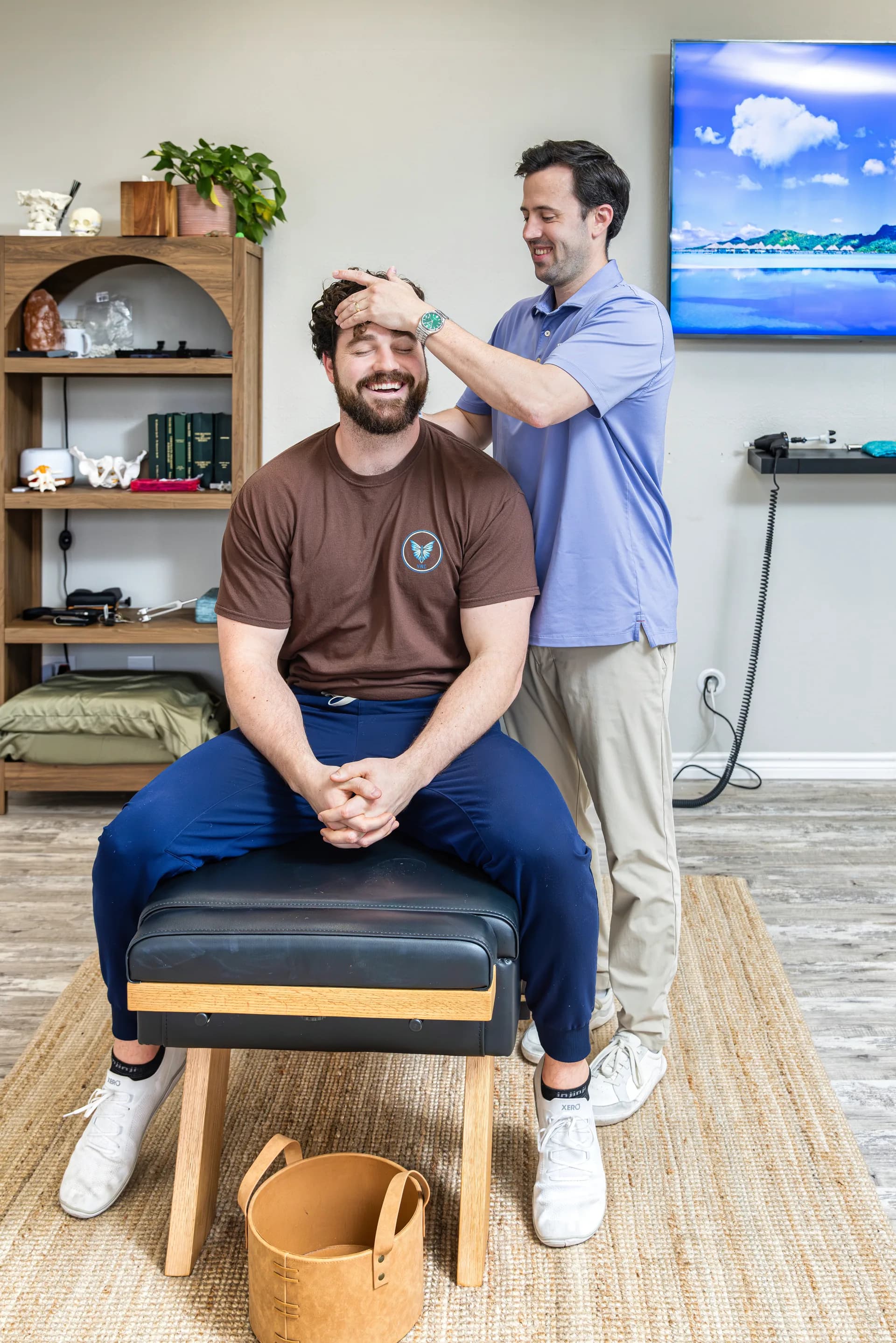
Look at the photo at the top of this post — that's our drop table in action. The Thompson technique, developed in the 1950s, uses a specially built table with segmented sections. The section supporting the area being adjusted raises slightly, and as I deliver a light impulse, that segment drops a fraction of an inch.
The drop does part of the work. Because the table moves with the adjustment, far less force travels through your body — I can use a fraction of the pressure a purely manual adjustment would require. Most patients describe it as a quick, gentle bump. If you've searched "drop table chiropractic" after seeing one of these tables online, this is it. There's a soft clunk when the segment drops, which people sometimes mistake for their own joints. It isn't. It's furniture.
Sustained Fingertip Pressure (Infants)
Babies are never adjusted the way adults are. Ever. For infants, we use sustained fingertip pressure — about the same pressure you'd use to test a ripe tomato, or to comfortably press on your own closed eyelid. Ounces of pressure, not pounds. No twisting, no popping, no cracking — those have no place in infant care.
Most babies stay calm through the whole visit, and plenty sleep right through it. If you're weighing this for your own little one, I've written a full breakdown of whether chiropractic is safe for babies, and you can read exactly what our pediatric chiropractic care involves.
Webster Technique (Pregnancy)
The Webster Technique is a specific assessment and gentle adjustment protocol for pregnancy, focused on balancing the sacrum and pelvis. Care is done side-lying with pregnancy pillows, and there is never pressure on your belly. I'm Webster certified, and this technique is the foundation of our prenatal care. If you're expecting, I've explained how the Webster Technique works in detail.
Types of Chiropractic Adjustments You May See at Other Offices
For a complete picture, here are two methods you'll commonly encounter elsewhere. I want you to recognize them, even though they're not how we practice.
Diversified technique (manual HVLA). HVLA stands for high-velocity, low-amplitude — a fast, shallow, controlled thrust delivered by hand, usually with the classic audible pop. It's the most widely used technique in the profession and the one most people picture when they hear the word "chiropractor." Our gentle manual adjusting is a low-force relative of this approach, but the forceful, whole-spine version you've seen in videos is not something we do. On anyone.
Flexion-distraction. A specialized table gently stretches and flexes the spine in a slow, rhythmic motion — no thrust, no pop. It's most often used in offices that focus on disc injuries. We don't use flexion-distraction at Trinity Life. If your exam suggests you'd genuinely be better served by it, or by a different type of provider entirely, I'll tell you that plainly and point you in the right direction.
How We Choose the Right Method for You
At a lot of offices, the technique is decided before you ever walk in — it's simply whatever that doctor does to everybody. We work in the opposite direction. Four things drive the decision:
- Objective scan data. Every new patient gets INSiGHT nervous system scans — thermal, surface EMG, and heart rate variability — before any care begins. The scans show us where your nervous system is under stress, so the plan is built on measurement, not guesswork.
- Your age. An eight-week-old gets fingertip pressure only. A seven-year-old usually gets instrument adjusting or feather-light hands-on work. A pregnant mom gets Webster. A healthy adult has the full toolkit available.
- Your body. Size, bone density, health history, past injuries, and how you've responded to care so far all shape the approach.
- Your comfort. This one is non-negotiable. If you never want a manual adjustment, you will never get one. Nobody in our office will talk you into a technique that scares you — a body that's bracing against the adjustment is working against it.
And the choice isn't permanent. We re-scan at regular intervals, and as your nervous system changes, the methods often change with it.
Afraid of the "Crack"? You Have Gentle Options
If fear of manual adjusting has kept you away from chiropractic care, here's the honest bottom line: you can receive complete care in our office without ever being twisted or popped.
Between the instrument and the drop table, we can restore joint motion with your spine in a neutral, relaxed position from your first visit to your last. What makes an adjustment work is accuracy — the right joint, the right direction, the right amount of force — not how dramatic it sounds. In our experience, some of the best scan improvements come from patients who never receive a single traditional manual adjustment.
So tell us you're nervous. You won't be the first person to say it that week.
Adjusting Kids vs. Adults: What Actually Changes
Parents ask about this constantly, so let me be specific. Kids are not small adults, and the force involved scales down dramatically:
- Infants: sustained fingertip pressure only — ounces of force. No exceptions.
- Toddlers and young kids: instrument adjusting or very light hands-on contacts. Quick, playful, and usually finished before they're done telling me about their day.
- Teens: closer to adult care, but still lighter — growing bodies generally need less input.
- Adults: the full toolkit, matched to scan findings, history, and comfort.
The goal never changes: better joint motion and better nervous system communication. The amount of force is what changes, and for little ones it's a tiny fraction of what adults receive.
What Your First Adjustment Is Actually Like
Here's something that surprises people: at Trinity Life, your first visit isn't an adjustment at all. It's a conversation, an exam, and INSiGHT scans — so that when I recommend a method, the recommendation is built on real information about your nervous system, not a hunch. I've walked through the whole experience in what to expect at your first chiropractor visit.
Our $150 New Patient Special covers all of it: a comprehensive consultation, a physical exam, the full set of INSiGHT scans, and a report of findings where I explain exactly what we found and which methods I'd recommend for you — and why. The regular price is $350. There's no pressure at the end and nothing to commit to. You get information; you make the call.
If the only thing standing between you and care is fear of what an adjustment might feel like, come find out how gentle this can actually be.
About the author
Dr. Colton O'Brien
Founder of Trinity Life Chiropractic — a family practice in Allen, TX. Parker University DC, Webster Technique certified, INSiGHT pediatric-trained.
Frequently asked questions
What is the Activator method?
The Activator method uses a small, handheld, spring-loaded instrument to deliver a quick, precisely targeted impulse to a specific joint. There's no twisting, no bending, and no popping sound — your body stays in a neutral position the whole time. Most people describe it as a light tap. It's one of the gentlest chiropractic adjustment methods available.
What is a drop table in chiropractic?
A drop table has segmented sections that raise slightly and then drop a fraction of an inch as the chiropractor delivers the adjustment. The table's drop does part of the work, which means far less force travels through your body. It's called the Thompson technique, and it feels like a quick, gentle bump rather than a twist or crack.
Do chiropractic adjustments have to crack or pop?
No. The popping sound is gas releasing from the fluid inside a joint as pressure changes — it's not bones cracking, and it's not required for an adjustment to work. Instrument-assisted and drop-table methods restore joint motion with no popping at all. The sound is a side effect of some techniques, never the goal.
Which chiropractic adjustment method is best?
There's no single best method — the right technique depends on your age, your body, your health history, and your comfort level. At Trinity Life, we use INSiGHT nervous system scans to see objectively where your body needs help, then match the method to you. An infant, a pregnant mom, and a construction worker all need different approaches.
Are gentle chiropractic techniques as effective as manual adjustments?
In our experience, yes — what makes an adjustment effective is accuracy, not force. The goal is restoring motion to a restricted joint and improving nervous system communication, and gentle instrument and drop-table methods accomplish that with far less physical stress. Some of the best results in our office come from patients who never receive a traditional manual adjustment.
Keep reading
More from our practice.

How to Find a Family Chiropractor in Allen, TX
New to Allen? Here's how to find a family chiropractor who fits your whole household — what to look for, what to ask, and how to book.

Chiropractic for Colic: A Gentle Approach to Fussy Babies
Chiropractic for colic uses gentle, sustained-contact adjustments that may calm a fussy baby's nervous system. Here's how the approach works.

Postpartum Chiropractic Care: The Fourth Trimester
Postpartum chiropractic care can help new moms recover in the fourth trimester with gentle, Webster-certified support for the pelvis, spine, and posture.
Our services
How we can help.
ADHD & Sensory Care
Quieting the Storm Inside
Back Pain Relief
Drug-Free Back Pain Treatment in Allen, TX
Colic & Reflux Relief
Soothing the Unsettled Baby
Ear Infections & Immunity
Breaking the Antibiotic Cycle
Family Chiropractic
Wellness for the Whole Household
Kids & Teens
Navigating Growth Spurts and School Stress
Conditions we treat
Common concerns families bring us.
Chronic Neck Pain
Neck pain that lingers for weeks or months is rarely just muscle tightness. It's usually a sign of spinal misalignment creating nerve interference, chronic muscle tension, and progressive degeneration that won't resolve on its own.
Constipation (Infant & Child)
Constipation in babies and children is often linked to nervous system interference affecting gut motility and digestive function. Gentle chiropractic adjustments help restore proper nerve communication to the digestive system, offering relief without medication.
Growing Pains
Growing pains are common in children, but they're often dismissed as normal when they may indicate spinal tension, muscular imbalance, or nervous system stress that responds well to gentle chiropractic care.
Headaches & Migraines
Recurring headaches and migraines are often caused by tension and misalignment in the upper cervical spine, which interferes with blood flow and nerve function. Chiropractic care addresses the structural root cause rather than masking the pain with medication.
Poor Sleep & Insomnia
Poor sleep affects everything — mood, focus, immune function, and healing. When the nervous system is stuck in a stressed state, the body physically cannot wind down for restful sleep, no matter how many supplements or sleep hygiene tips you try.
Postpartum Back Pain
Postpartum back pain affects the majority of new mothers as the body recovers from pregnancy, labor, and the physical demands of caring for a newborn. The structural shifts from pregnancy don't always self-correct — chiropractic care speeds recovery and restores pelvic balance.
From the article to the table
See what your nervous system is actually doing — $150 first visit.
228 five-star Google reviews