Pediatric Health
8 Signs Your Child Needs a Chiropractor (Ages 2–17)

Kids rarely announce that something's wrong. They show you — through posture, sleep, headaches, and focus. Here are 8 signs your child's nervous system may need support, from an Allen, TX pediatric chiropractor.
Toddlers and teenagers have one thing in common: they almost never walk up to you and say, "My spine feels restricted and I think my nervous system is under stress." Instead, you get clues. A slouch that wasn't there last year. Another headache after school. A meltdown that feels bigger than the moment that caused it. Most parents who call our office can't name exactly what's wrong — they just know something is off.
I'm going to help you read those clues. As a pediatric chiropractor here in Allen, TX, I spend most of my week with kids, and the signs your child needs a chiropractor look different at age four than they do at fourteen — but they trace back to the same place: a nervous system carrying more stress than it can process.
One note before we start. This post covers walking-age kids through teenagers — roughly ages 2 to 17. If you have an infant and you're seeing feeding struggles, a head tilt, or a flat spot developing, read 7 signs your baby may need a chiropractor instead. Babies show nervous system stress through feeding, sleeping, and settling. Older kids show it in the eight ways below.
1. Regular Headaches or Neck and Back Pain
What you see at home: your child rubs their neck after school, says "my head hurts" more than once in a while, or complains about their back after sitting through homework.
Here's my honest position: occasional aches happen, but regular pain is not normal for a child. Kids are not supposed to need ibuprofen every week. When a child's headaches keep returning, the source is often tension in the upper neck — the same screens-and-backpack loading pattern I see in adults, arriving a decade early. The joints and muscles at the top of the spine refer pain into the head, and no amount of water or early bedtimes changes the underlying mechanics.
When to involve your pediatrician: a sudden severe headache, a headache with fever or vomiting, vision changes, or any headache after a hard fall needs a physician first — same day, no waiting. Chiropractic care is for the recurring pattern, not the emergency.
2. Posture Changes You Can Spot Across the Room
What you see at home: slouching at the dinner table, one shoulder sitting higher than the other, or a head that juts forward toward every screen.
Two modern realities drive this. First, the backpack: pediatric organizations have long advised keeping a loaded backpack somewhere around 10 to 20 percent of a child's body weight, and plenty of middle schoolers carry more than that — on one shoulder. Second, tech neck: for every inch the head drifts forward, the muscles of the neck and upper back have to work dramatically harder to hold it up, and kids log hours a day in that position.
Posture isn't laziness. It's an output of the nervous system, and chronic slouching both reflects and reinforces spinal tension.
When to involve your pediatrician: if you notice a visible curve in the spine, uneven hips, or a rib hump when your child bends forward, ask about a scoliosis screening. That's a both/and situation — screen medically, support structurally.
3. Growing Pains That Disrupt Sleep
What you see at home: aching legs at night — calves, thighs, behind the knees — sometimes waking your child up crying, then gone by breakfast.
"Growing pains" is a label, not an explanation. Growth itself doesn't hurt. What we often find in these kids is accumulated muscle tension and a nervous system working overtime to coordinate a body that's changing fast. When we address growing pains at our office, we look at how the low back, pelvis, and legs are moving and how the nervous system is regulating tension — instead of just waiting for your child to age out of it.
When to involve your pediatrician: pain that lives in one specific spot, comes with swelling or limping, shows up during the day, or pairs with a fever isn't a growing pain. Get that evaluated medically first.
4. Restless Sleep or Trouble Falling Asleep
What you see at home: it takes an hour of callbacks and negotiations for your child to settle, they toss all night, or they wake up looking like they never actually rested.
Falling asleep is a nervous system skill. The body has to downshift from its sympathetic "gas pedal" into its parasympathetic "brake" — and a child whose nervous system is stuck in stress mode physically can't make that shift, no matter how consistent your bedtime routine is. This is one of the most common patterns we find in kids with poor sleep, and better sleep is often the first change parents report once care begins.
Honest note: screens before bed, sugar, and inconsistent schedules sabotage sleep too — address those alongside care. And if your child snores heavily or pauses breathing at night, see your pediatrician. That's a medical question.
5. The Constant Illness Cycle
What you see at home: back-to-back ear infections, a cold that never fully clears, a kid who catches everything the classroom passes around.
Let me be precise here, because this is where some chiropractic marketing gets sloppy: chiropractic does not treat infections. What we address is the stress physiology underneath. A nervous system stuck in fight-or-flight diverts resources away from rest, digestion, and immune regulation. When we reduce that interference, we're supporting the body's own resilience — and many families tell us the sick-all-winter pattern loosens its grip over time.
When to involve your pediatrician: every infection deserves medical eyes. Diagnosis, antibiotic decisions, ear tube conversations — those belong to your pediatrician. We work alongside that care, never instead of it.
6. Trouble Focusing, Sensory Overwhelm, or After-School Meltdowns
What you see at home: notes from the teacher about attention, homework that dissolves into tears, sock seams that ruin entire mornings, or a kid who holds it together all day and detonates at 4 p.m.
That last one is the classic. Holding it together takes enormous nervous system effort, and a child running in stress mode all day has nothing left in the tank by pickup. I want to be careful with claims here: chiropractic does not treat ADHD or sensory processing disorder. But focus and self-regulation depend on a nervous system that can shift gears, and our ADHD and sensory support care is built around measuring and reducing that stuck-in-overdrive pattern. Many parents report a calmer, more adaptable kid — which tends to make every other therapy and strategy work better.
Honest note: keep your pediatrician, therapist, and school team in the loop. We're one piece of support, not a replacement for a proper evaluation.
7. Sports Impacts, Repetitive Strain, or Slow Recovery
What you see at home: your athlete limps out of practice more weeks than not, shakes off hard hits without a second look, or nurses the same nagging complaint all season.
Youth sports have changed. Kids specialize in one sport earlier and play it year-round, which means the same joints absorb the same one-sided stress thousands of times — pitching shoulders, kicking hips, tumbling spines. Small restrictions that never get addressed change how a young athlete moves, and the compensation usually shows up somewhere else entirely: the knee that hurts because the pelvis stopped moving well.
When to involve your pediatrician: any suspected concussion, numbness or tingling, or severe pain goes to medical care first — always. We're the follow-up that helps the body move and recover well, not the emergency room.
8. Toe Walking, Tripping, or Uneven Shoe Wear
What you see at home: a child who still walks on their toes well past toddlerhood, trips more often than their friends do, or wears down one shoe heel noticeably faster than the other.
Gait is one of the most honest windows into the nervous system, because walking is a full-body coordination task the brain runs automatically. Asymmetric shoe wear means asymmetric loading — somewhere between the feet and the spine, your child's body is favoring a side. Most parents never think to connect shoe wear to the spine. Go check your kid's shoes tonight.
When to involve your pediatrician: persistent toe walking deserves a pediatric evaluation too, since it can relate to muscle tightness or developmental factors that need medical assessment. Another both/and, not either/or.
How a Chiropractor for Kids Adjusts Differently
If the word "adjustment" makes you picture twisting and cracking, let that image go. That's not what kids chiropractic care looks like — for young children, there is no twisting and no popping, ever.
What we actually use, scaled to age and size:
- Sustained gentle pressure for the littlest kids — closer to holding a point than "adjusting" it
- Instrument-assisted adjustments (Activator-style) — a small, measured pulse from a handheld tool that most kids find funny rather than scary
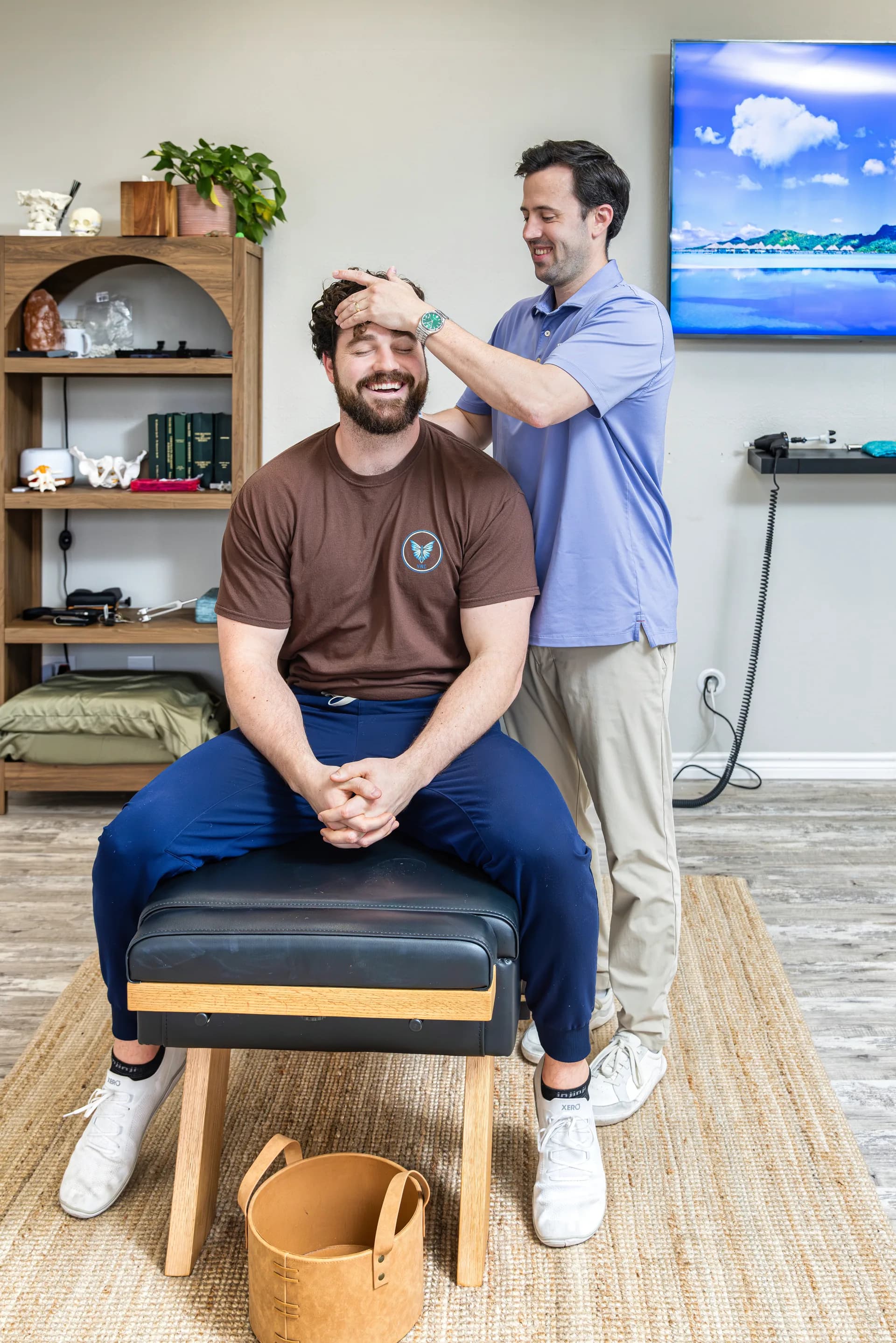
- Thompson drop-table work for bigger kids and teens — the table does the work, using a fraction of the force of a manual adjustment
- Gentle manual adjustments where they're appropriate, always matched to the child in front of me
Visits are quick, and most kids genuinely enjoy them. We have plenty of families where the kids argue over who gets adjusted first.
What Chiropractic Care for a Child Looks Like at Trinity Life
Here's the core problem with evaluating a seven-year-old: they can't always articulate what's wrong. "My tummy feels weird" might mean nausea, anxiety, or nothing at all.
That's why we don't rely on your child's ability to describe symptoms. Our INSiGHT scans measure the nervous system directly — a thermal scan, surface EMG, and heart rate variability. Three scans, no needles, nothing invasive, and your child doesn't have to explain a thing. The scans show us where their nervous system is carrying stress, objectively.
A pediatric new patient visit is $150 (regular price $350) and includes the full consultation, a physical exam, the INSiGHT scans, and a report of findings where I walk you through exactly what we found in plain English.
Then you decide. No high-pressure pitch, no scare tactics. We've cared for 500+ families across Allen and the surrounding cities, and that's not how we got there.
We Work With Your Pediatrician, Not Instead of Them
I'm a member of the ICPA (International Chiropractic Pediatric Association), and I'll tell you the same thing that training emphasizes: pediatric chiropractic complements medical care. It doesn't replace it.
Your pediatrician handles diagnosis, illness, medication, and developmental milestones. We handle the structural and nervous system side — how your child's body is adapting to growth, gravity, backpacks, sports, and stress. Fever, trauma, or anything neurologically alarming goes to a physician first, full stop. You should never feel like you're choosing sides, and any provider who makes you feel that way — in either direction — has earned your skepticism.
Trust What You're Noticing
Nobody knows your child like you do. If two or three of these signs sound like your kid, that's not a diagnosis — it's a reason to get objective answers instead of wondering for another six months.
The scans either show nervous system stress or they don't. Either way, you'll know.
About the author
Dr. Colton O'Brien
Founder of Trinity Life Chiropractic — a family practice in Allen, TX. Parker University DC, Webster Technique certified, INSiGHT pediatric-trained.
Frequently asked questions
At what age can a child see a chiropractor?
There's no minimum age — I check newborns just days old, and techniques scale with the child. For toddlers through teens, we use gentle, age-appropriate adjustments matched to their size and development. The real question isn't age; it's whether the provider has pediatric training. Ask about certifications and experience with kids before you book anywhere, including with us.
Is chiropractic care safe for kids?
When performed by a provider trained in pediatric techniques, chiropractic care for kids is gentle and well tolerated. We never use the twisting, cracking style you might picture — young children get light sustained pressure or instrument-assisted adjustments using a fraction of adult force. We also screen every child first and refer to a physician when something falls outside our scope.
Can a chiropractor help my child's posture?
Often, yes — but honestly, adjustments alone won't outwork twelve hours a day of slouching. We address the spinal tension and alignment issues that make good posture feel hard, then give your child practical habits for backpacks, screens, and sitting. Many parents notice their child standing taller within weeks, but lasting change comes from care plus daily habits together.
How is a kids' chiropractic adjustment different from an adult's?
Everything is scaled down. Young kids get gentle sustained pressure or a small instrument-assisted pulse — no twisting, no popping. Older kids and teens may get light manual adjustments or drop-table work, still far gentler than adult care. Visits are quick, most kids think the table is fun, and many ask to go first when the whole family comes in.
Does insurance cover chiropractic care for kids?
Many plans cover chiropractic care for children, though the details vary — call the number on your card and ask about visit limits, copays, and referral requirements. At Trinity Life, our pediatric new patient assessment is a flat $150, and we discuss all costs before any care begins. If insurance makes more sense for your family, we'll tell you.
Keep reading
More from our practice.

How to Find a Family Chiropractor in Allen, TX
New to Allen? Here's how to find a family chiropractor who fits your whole household — what to look for, what to ask, and how to book.

Chiropractic for Colic: A Gentle Approach to Fussy Babies
Chiropractic for colic uses gentle, sustained-contact adjustments that may calm a fussy baby's nervous system. Here's how the approach works.

Postpartum Chiropractic Care: The Fourth Trimester
Postpartum chiropractic care can help new moms recover in the fourth trimester with gentle, Webster-certified support for the pelvis, spine, and posture.
Our services
How we can help.
ADHD & Sensory Care
Quieting the Storm Inside
Back Pain Relief
Drug-Free Back Pain Treatment in Allen, TX
Colic & Reflux Relief
Soothing the Unsettled Baby
Ear Infections & Immunity
Breaking the Antibiotic Cycle
Family Chiropractic
Wellness for the Whole Household
Kids & Teens
Navigating Growth Spurts and School Stress
Conditions we treat
Common concerns families bring us.
Chronic Neck Pain
Neck pain that lingers for weeks or months is rarely just muscle tightness. It's usually a sign of spinal misalignment creating nerve interference, chronic muscle tension, and progressive degeneration that won't resolve on its own.
Constipation (Infant & Child)
Constipation in babies and children is often linked to nervous system interference affecting gut motility and digestive function. Gentle chiropractic adjustments help restore proper nerve communication to the digestive system, offering relief without medication.
Growing Pains
Growing pains are common in children, but they're often dismissed as normal when they may indicate spinal tension, muscular imbalance, or nervous system stress that responds well to gentle chiropractic care.
Headaches & Migraines
Recurring headaches and migraines are often caused by tension and misalignment in the upper cervical spine, which interferes with blood flow and nerve function. Chiropractic care addresses the structural root cause rather than masking the pain with medication.
Poor Sleep & Insomnia
Poor sleep affects everything — mood, focus, immune function, and healing. When the nervous system is stuck in a stressed state, the body physically cannot wind down for restful sleep, no matter how many supplements or sleep hygiene tips you try.
Postpartum Back Pain
Postpartum back pain affects the majority of new mothers as the body recovers from pregnancy, labor, and the physical demands of caring for a newborn. The structural shifts from pregnancy don't always self-correct — chiropractic care speeds recovery and restores pelvic balance.
From the article to the table
See what your nervous system is actually doing — $150 first visit.
228 five-star Google reviews