Pregnancy
Postpartum Recovery and Chiropractic: Getting Your Body Back After Birth

Your body just did something enormous — and now it hurts in ways nobody warned you about. Here's what really happens postpartum, when chiropractic can help, and how we care for new moms in Allen, TX.
You spent nine months taking care of your body for the baby. Then the baby arrived, and overnight every question became about the baby — how's the baby sleeping, how's the baby eating, is the baby gaining weight. Somewhere in there, you became a supporting character in your own recovery. I see it in our office every week. This post is about you.
If you're reading this at 3 a.m. with a baby asleep on your chest, wondering whether a postpartum chiropractor is a real thing or just something the mom groups mention — it's real, and you're not being dramatic for looking into it. Your body did something enormous. It's allowed to hurt. But hurting for months on end isn't a membership fee you owe for becoming a mother. Let's walk through what actually happens to your body after birth, why the pain shows up where it does, and when chiropractic care makes sense.
What Actually Happens to Your Body After Birth
Pregnancy gets nine months of attention. The fourth trimester — the twelve or so weeks after birth — gets a six-week checkup and a "you're all clear." That gap is where most postpartum pain lives.
Here's what's really going on under the surface:
Relaxin is still in the picture. Relaxin is the hormone that loosened your ligaments during pregnancy so your pelvis could expand for birth. It doesn't switch off in the delivery room. Research suggests the ligament looseness of pregnancy can persist for months after delivery — and for many moms, it hangs around as long as they're breastfeeding. That's why your joints can feel wobbly at five, eight, even twelve months postpartum. You're not imagining it.
Your pelvis is finding a new position. Your pelvis spent months tilting and widening to make room for a growing baby, then went through birth. Now it has to settle back into a stable, balanced position. Sometimes it does that smoothly. Often it settles unevenly, and the imbalance shows up as postpartum back pain, hip pain, tailbone pain, or that deep ache that flares every time you stand up holding the baby. If you've been searching for postpartum back pain relief and finding nothing but generic stretches, this is usually the missing piece.
Your core and pelvic floor are rebuilding from scratch. Your abdominal muscles stretched and often separated — the medical term is diastasis recti — and your pelvic floor either stretched through a vaginal delivery or supported a full pregnancy before a cesarean. Until those deep stabilizing muscles come back online, your spine takes load it isn't used to handling. We screen for this, and when pelvic floor physical therapy needs to be part of the answer, we say so — we work alongside your medical providers, not instead of them.
C-section moms are recovering too — from more, not less. I want to say this clearly, because cesarean moms sometimes assume the recovery conversation isn't for them: a C-section is major abdominal surgery stacked on top of a full pregnancy's worth of postural change and ligament laxity. Your recovery is just as real, and in some ways it's a bigger lift. We simply adapt everything — positioning, technique, pressure — around your healing incision.
The Feeding-Posture Problem Nobody Warns You About
Here's the pattern I see most in new moms, and it has nothing to do with the birth itself.
Feeding a newborn — breast or bottle, doesn't matter — means eight to twelve sessions a day spent looking down at a baby with your shoulders rolled forward, mid-back rounded, and neck craned. That's hours every single day in the exact posture your spine tolerates worst. Then add:
- Lifting, constantly. Out of the crib, the car seat, the bassinet, the swing — dozens of times a day, usually while bending and twisting at the same time.
- The car seat carry. A loaded infant carrier commonly weighs 15 to 20-plus pounds, hauled on one forearm at an angle your body was never designed for.
- Babywearing. Wonderful for the baby, real load for you — especially when the carrier hangs the weight off your shoulders instead of your hips.
- Contact naps. You finally get the baby to sleep on you, and now you're pinned in one position for an hour, afraid to move a muscle. Multiply by months.
- "Mom thumb" and its neighbors. That burning at the base of your thumb and wrist comes from scooping up the baby with splayed hands all day — and the same repetitive lifting pattern loads your shoulders and neck right along with it.
None of these are dramatic injuries, which is exactly why they get dismissed. It's the accumulation — small stresses repeated hundreds of times a week on a body that's still hormonally loose — that produces the neck, shoulder, and mid-back pain so many moms describe around month three or four.
The Sleep-Deprivation and Pain Loop
Pain and exhaustion feed each other, and new moms live in the middle of that loop.
When you're chronically sleep-deprived, your nervous system shifts toward stress mode — the sympathetic "gas pedal" stays pressed down while the parasympathetic "brake," the rest-and-repair side, barely gets used. A stressed nervous system amplifies pain signals and slows recovery. So the pain feels worse, which makes your broken sleep even less restorative, which leaves your body less able to heal, which keeps the pain going.
This is one reason we measure instead of guess. Our INSiGHT scans — including heart rate variability, a measure of how flexibly your nervous system shifts between stress and recovery — show us objectively how much load your system is carrying. Many postpartum moms look at their scan results and finally have language for what they've been feeling: my body is stuck in go mode.
When Can You See a Chiropractor After Birth?
The honest answer: it depends on you, your birth, and your recovery. But here's the framework I give moms who ask.
The common starting point is around the six-week checkup. Most moms wait until their OB or midwife has looked everything over and has no concerns. That's a reasonable default — especially after a C-section, where the incision needs time to heal. Worth knowing: the American College of Obstetricians and Gynecologists (ACOG) now frames postpartum care as an ongoing process rather than a single visit — your recovery deserves attention over months, not one appointment.
Gentle techniques can be appropriate earlier for some moms. What we do postpartum — light instrument-assisted adjustments, Thompson drop-table work, careful side-lying positioning with pillows — is a world away from aggressive twisting. Some moms come in within the first few weeks for neck and upper-back relief while everything below stays hands-off. And if you were under chiropractic care during pregnancy, continuing after birth is usually a smooth handoff, because we already know your body.
It's individual, and we treat it that way. We assess before we adjust. If your body isn't ready for something, we don't do it. And if what you need first is your OB, a pelvic floor PT, or simply more healing time, I'll tell you that directly.
Pelvic balance matters after birth just like it did before: the same principles behind the Webster Technique — restoring balance to the pelvis and the ligaments around it — shape how we approach a postpartum pelvis settling into its new normal.
What Postpartum Chiropractic Care Looks Like at Trinity Life
Our postpartum chiropractic care starts the way all care starts here: with a real assessment, not a quick crack.
Your first visit is $150 — regularly $350 — and includes a comprehensive consultation, a physical exam, INSiGHT nervous system scans (thermal, surface EMG, and heart rate variability), and a report of findings where I explain what we found in plain English. No pressure, no surprise sales pitch at the end. You get answers, then you decide.
From there, care is built around techniques suited to a postpartum body: gentle manual adjustments, instrument-assisted work, drop-table adjustments, and side-lying positioning when your abdomen or incision is still tender.
And the logistics are built for actual moms, because our practice has cared for 500-plus families and counting:
- Yes, bring the baby. Car seat next to the table, stroller in the room, whatever works. Nobody here blinks at a crying newborn.
- Feeding breaks are fine. If the baby needs to eat mid-visit, we pause. This is normal here.
- Many moms book the baby's first check for the same visit. Birth is physically demanding for babies too, and gentle fingertip pressure — about what you'd use to test a ripe tomato — is all we ever use. If you're curious what that looks like, I wrote a full newborn chiropractic guide.
And if you're reading this while still pregnant, trying to get ahead of all of it — good instinct. Start with our $150 Prenatal New Patient Special, and your postpartum self will thank you.
A Realistic Postpartum Recovery Timeline
I won't hand you a fake number. Timelines vary with your birth, your sleep, your support at home, and how long you've been pushing through pain. Here's what I can tell you honestly:
- Many moms notice a difference within the first few visits — often in how they sleep and in that constant tension between the shoulder blades.
- Meaningful, stable change usually takes weeks to a few months. Your ligaments are still lax and your daily load is literally growing heavier every month, so consistency beats intensity.
- The fourth trimester is a starting line, not a deadline. If your baby is ten months old and you're only now getting to this, you didn't miss the window. There is no window. We see moms at six weeks and at two years postpartum, and both get better.
Expect us to re-scan along the way. Progress you can see on paper beats "trust me, it's working."
When to Call Your OB First
Chiropractic has a lane, and I stay in it. Some postpartum symptoms need your OB or midwife today — before anyone touches your spine:
- Heavy bleeding — soaking through a pad in an hour, or bleeding that suddenly picks back up
- Signs of infection — fever, chills, foul-smelling discharge, or an incision that's red, hot, or draining
- A severe headache that won't quit, especially with vision changes or new swelling — this can signal postpartum preeclampsia, which can show up weeks after delivery
- Chest pain, trouble breathing, or a painful, swollen leg
And one that matters as much as any of the physical ones: if your mood is scaring you — hopelessness, rage, intrusive thoughts, feeling like your family would be better off without you — that is a medical situation, it is treatable, and it is not a character flaw. Call your provider, and if you're in crisis, call or text 988. You deserve care for that as urgently as anything else on this list.
You're Allowed to Be the Patient
Here's my honest take on "getting your body back": your body never left. It grew a person, delivered a person, and has been carrying that person ever since. It doesn't need to be gotten back. It needs to be taken care of — by someone whose whole job is to focus on you for once.
That's what the first visit is for. Our $150 New Patient Special covers the complete assessment — consultation, exam, INSiGHT scans, and a clear report of findings — so you know exactly what's going on before committing to anything. Want the baby checked too? Ask about our pediatric new patient special and we'll take care of you both in one trip.
You've spent months making sure everyone else is okay. This appointment is yours.
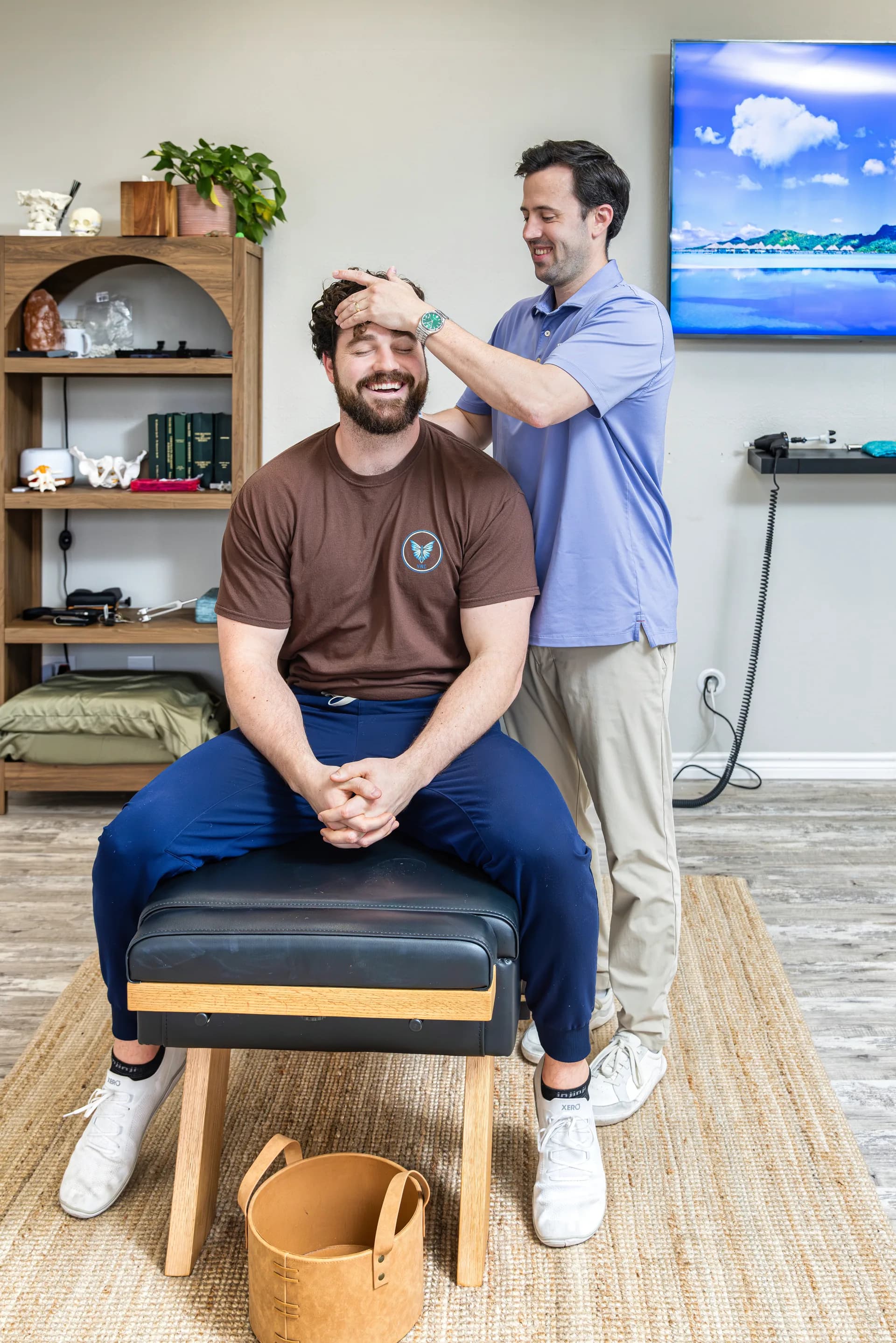
About the author
Dr. Colton O'Brien
Founder of Trinity Life Chiropractic — a family practice in Allen, TX. Parker University DC, Webster Technique certified, INSiGHT pediatric-trained.
Frequently asked questions
How soon after birth can I see a chiropractor?
Many moms start around or after their six-week postpartum checkup, once their OB or midwife has no concerns. Gentle, low-force techniques can be appropriate earlier for some women. It's individual — your birth, your recovery, your timeline. At Trinity Life, we assess first and only recommend care your body is actually ready for.
Can a chiropractor help with postpartum back pain?
Many women find real relief. Postpartum back pain usually comes from lingering ligament laxity, a pelvis that shifted through pregnancy and birth, and hours of feeding and carrying in hunched positions. Gentle adjustments help restore alignment while your body stabilizes, and we refer to pelvic floor physical therapy when that's part of the picture.
Is chiropractic care safe while breastfeeding?
Yes — there's nothing about a chiropractic adjustment that affects your milk supply or your baby. Breastfeeding is actually relevant the other way around: the hormone-driven ligament looseness of pregnancy often persists while you're nursing, which is one reason your joints can still feel loose or unstable many months after delivery.
Can I see a chiropractor after a C-section?
Yes, once your incision has healed and your OB has cleared you at your postpartum checkup. A C-section is major abdominal surgery, so we adapt everything — positioning, technique, and pressure. Your spine and pelvis still carried a full pregnancy, so cesarean moms often benefit from care just as much as moms who delivered vaginally.
Why does my back still hurt months after giving birth?
Because birth isn't the finish line for your body. Relaxin's effects on your ligaments can linger for months — often longer while breastfeeding — your pelvis is settling into a new position, and your core is rebuilding strength. Add hours of daily feeding and carrying, and pain six or twelve months out is common. Common doesn't mean permanent.
Keep reading
More from our practice.

How to Find a Family Chiropractor in Allen, TX
New to Allen? Here's how to find a family chiropractor who fits your whole household — what to look for, what to ask, and how to book.

Chiropractic for Colic: A Gentle Approach to Fussy Babies
Chiropractic for colic uses gentle, sustained-contact adjustments that may calm a fussy baby's nervous system. Here's how the approach works.

Postpartum Chiropractic Care: The Fourth Trimester
Postpartum chiropractic care can help new moms recover in the fourth trimester with gentle, Webster-certified support for the pelvis, spine, and posture.
Our services
How we can help.
ADHD & Sensory Care
Quieting the Storm Inside
Back Pain Relief
Drug-Free Back Pain Treatment in Allen, TX
Colic & Reflux Relief
Soothing the Unsettled Baby
Ear Infections & Immunity
Breaking the Antibiotic Cycle
Family Chiropractic
Wellness for the Whole Household
Kids & Teens
Navigating Growth Spurts and School Stress
Conditions we treat
Common concerns families bring us.
Chronic Neck Pain
Neck pain that lingers for weeks or months is rarely just muscle tightness. It's usually a sign of spinal misalignment creating nerve interference, chronic muscle tension, and progressive degeneration that won't resolve on its own.
Constipation (Infant & Child)
Constipation in babies and children is often linked to nervous system interference affecting gut motility and digestive function. Gentle chiropractic adjustments help restore proper nerve communication to the digestive system, offering relief without medication.
Growing Pains
Growing pains are common in children, but they're often dismissed as normal when they may indicate spinal tension, muscular imbalance, or nervous system stress that responds well to gentle chiropractic care.
Headaches & Migraines
Recurring headaches and migraines are often caused by tension and misalignment in the upper cervical spine, which interferes with blood flow and nerve function. Chiropractic care addresses the structural root cause rather than masking the pain with medication.
Poor Sleep & Insomnia
Poor sleep affects everything — mood, focus, immune function, and healing. When the nervous system is stuck in a stressed state, the body physically cannot wind down for restful sleep, no matter how many supplements or sleep hygiene tips you try.
Postpartum Back Pain
Postpartum back pain affects the majority of new mothers as the body recovers from pregnancy, labor, and the physical demands of caring for a newborn. The structural shifts from pregnancy don't always self-correct — chiropractic care speeds recovery and restores pelvic balance.
From the article to the table
See what your nervous system is actually doing — $150 first visit.
228 five-star Google reviews